Job Queue Pattern
How infrastructure operations are queued, claimed atomically, and executed by Tendrils.
Job Queue Pattern
Every infrastructure operation in the platform — planning, deploying, destroying, connecting cloud accounts — is modeled as a job in a PostgreSQL queue. Tendrils poll for jobs, claim them atomically, execute them, and report results.
Why a Job Queue?
Infrastructure provisioning is slow (minutes to hours) and must be reliable. A job queue provides:
- Decoupling — the web UI and CLI queue work without waiting for completion
- Exactly-once execution — atomic claiming prevents two Tendrils from running the same job
- Resumability — if a Tendril dies, the job can be retried from persisted Terraform state
- Auditability — every operation is logged with timestamps, status, and metadata
Job Types
| Type | Purpose | Triggered By |
|---|---|---|
CONNECTION_TEST | Verify cloud credentials, cache discovered resources | Connecting a cloud provider |
FETCH_RESOURCES | Refresh cached VPCs, subnets, hosted zones | Manual refresh in UI |
PLAN | Run terraform plan + optional Infracost analysis | Clicking "Plan" on a vine |
DEPLOY | Run terraform apply + install ArgoCD | Clicking "Apply" on a vine |
DESTROY | Run terraform destroy | Clicking "Destroy" on a vine |
DEPLOY_WORKER | Provision Tendril infrastructure (ECS task, IAM roles) | Adding a cloud-hosted Tendril |
UPDATE_WORKER | Update Tendril to latest release | Clicking "Update" on a Tendril |
DESTROY_WORKER | Tear down Tendril infrastructure | Removing a cloud-hosted Tendril |
Job Lifecycle
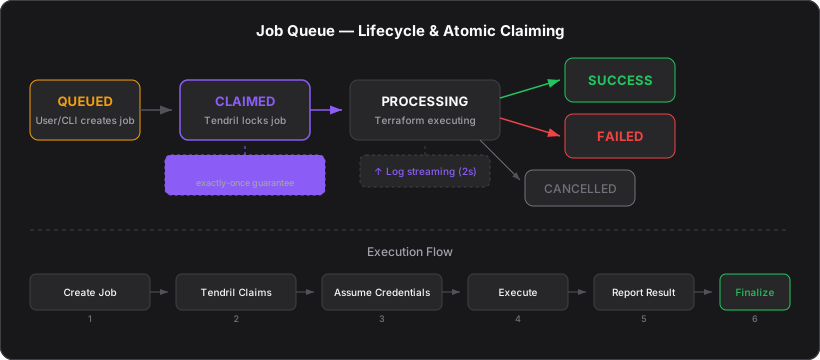
QUEUED ──► CLAIMED ──► PROCESSING ──► SUCCESS
                          │
                          ├──► FAILED
                          │
└──► CANCELLED| Status | Meaning |
|---|---|
QUEUED | Waiting for a Tendril to pick it up |
CLAIMED | A Tendril has locked it (prevents double-execution) |
PROCESSING | Tendril is actively running Terraform |
SUCCESS | Completed successfully |
FAILED | Failed with error message |
CANCELLED | User cancelled before completion |
Atomic Job Claiming
The critical invariant: exactly one Tendril executes each job. This is enforced by PostgreSQL's FOR UPDATE SKIP LOCKED:
CREATE OR REPLACE FUNCTION claim_next_job(p_worker_id uuid)
RETURNS provision_jobs AS $$
DECLARE
  job provision_jobs;
BEGIN
  SELECT * INTO job
  FROM provision_jobs
  WHERE status = 'QUEUED'
  ORDER BY created_at ASC
  FOR UPDATE SKIP LOCKED
  LIMIT 1;

  IF job IS NOT NULL THEN
    UPDATE provision_jobs
    SET status = 'CLAIMED',
        worker_id = p_worker_id,
        claimed_at = now()
    WHERE id = job.id;
  END IF;

  RETURN job;
END;
$$ LANGUAGE plpgsql;
FOR UPDATE SKIP LOCKED is the key mechanism. If Tendril A has locked a row, Tendril B's query skips it entirely rather than waiting. B either gets the next queued job or gets nothing. No distributed locks, no coordination — just PostgreSQL.
Config Snapshot
When a job is created, the current vine configuration is serialized as a config_snapshot in the job record. This ensures the Tendril executes exactly the configuration that was planned, even if the user modifies the vine after queuing.
For DEPLOY jobs, a plan hash is validated: if the vine config changed since the plan was generated, the deploy fails with a hash mismatch error, forcing the user to re-plan.
Job Execution Flow
Job Created
User clicks "Plan" / "Apply" / "Destroy" in the UI (or runs grape plan / grape harvest / grape destroy in the CLI). A provision_jobs row is inserted with status QUEUED.
Tendril Claims Job
A Tendril's poll loop calls POST /api/jobs/claim. The server executes claim_next_job(). If a job is returned, the Tendril proceeds.
Credential Assumption
The Tendril reads the cloud_identity from the job and assumes temporary credentials — STS AssumeRole (AWS), WIF token exchange (GCP), or federated identity (Azure).
Execution
The Tendril runs the job-type-specific logic (Terraform plan/apply/destroy, ArgoCD install, etc.) while streaming logs.
Result Reporting
On completion, the Tendril calls PUT /api/jobs/{id}/status with SUCCESS or FAILED, plus execution metadata (Terraform outputs, cost data, cluster info).
Finalization
For DEPLOY jobs, Trellis calls finalizeDeployment() to extract cluster metadata from Terraform outputs and update the vine's component tables (cluster endpoint, ArgoCD URL, database endpoints, etc.).
Failure Recovery
When a Tendril dies mid-job:
- Heartbeat stops → Trellis marks Tendril OFFLINE after 60 seconds
- Job stays in PROCESSING with no new log updates
- After 5 minutes of no log activity, Trellis marks the job FAILED
- User can retry the job — creates a new job with the same config
- Terraform state is preserved in Supabase S3, so the retry continues from the last successful state
Real-time Status Updates
Job status changes are broadcast via Supabase Realtime. The UI subscribes to provision_jobs UPDATE events and updates the jobs store in real-time. The job detail page also subscribes to provision_job_logs INSERT events for live log streaming.