Real-time Architecture
How Supabase Realtime powers live log streaming, job status updates, and store synchronization.
Real-time Architecture
The platform uses Supabase Realtime (built on PostgreSQL's logical replication) to push live updates to the browser. Three features depend on this: log streaming, job status updates, and Tendril status tracking.
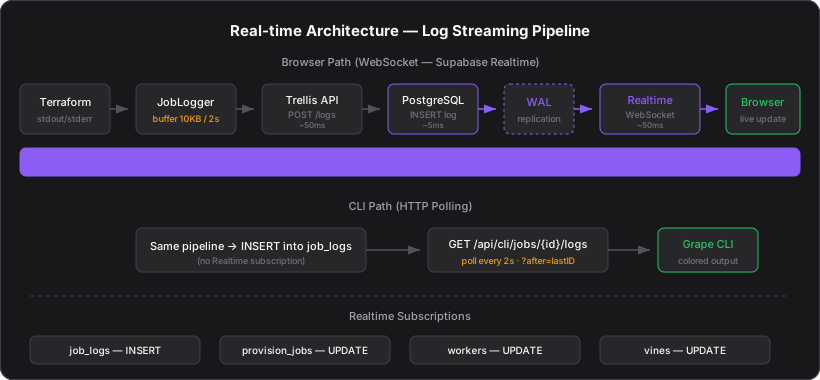
How Supabase Realtime Works
Supabase Realtime listens to PostgreSQL's Write-Ahead Log (WAL) and broadcasts row-level changes over WebSocket channels. Clients subscribe to specific tables and event types (INSERT, UPDATE, DELETE) with optional row-level filters.
PostgreSQL WAL ──► Supabase Realtime Server ──► WebSocket ──► BrowserLog Streaming
The most latency-sensitive use case. When a Tendril executes Terraform, stdout/stderr are streamed to the browser in near real-time.
Data Flow
Tendril writes logs
The JobLogger buffers Terraform output and flushes every 2 seconds (or when the buffer exceeds 10KB) via POST /api/jobs/{id}/logs.
Trellis inserts into database
The API route inserts the log chunk into provision_job_logs with a stream type (STDOUT, STDERR, or SYSTEM).
Supabase broadcasts INSERT
The provision_job_logs table is part of the supabase_realtime publication. Every INSERT triggers a broadcast.
Browser receives chunk
The job detail page subscribes to INSERT events on provision_job_logs filtered by job_id. New chunks appear in the log viewer within milliseconds.
Client Subscription
supabase
  .channel(`job-logs-${jobId}`)
  .on('postgres_changes', {
    event: 'INSERT',
    schema: 'public',
    table: 'provision_job_logs',
    filter: `job_id=eq.${jobId}`
  }, (payload) => {
    appendLog(payload.new.log_chunk, payload.new.stream_type);
  })
  .subscribe();
End-to-End Latency
| Step | Latency |
|---|---|
| Terraform → JobLogger buffer | ≤ 2 seconds |
| POST to Trellis API | ~50ms |
| Database INSERT | ~5ms |
| Realtime broadcast | ~50ms |
| Total | ~2–3 seconds |
Job Status Updates
The dashboard layout subscribes to provision_jobs changes to update the jobs store in real-time.
Subscription (Dashboard Layout)
supabase
  .channel('job-updates')
  .on('postgres_changes', {
    event: '*',  // INSERT, UPDATE, DELETE
    schema: 'public',
    table: 'provision_jobs',
    filter: `user_id=eq.${userId}`
  }, (payload) => {
    jobsStore.addOrUpdateJob(payload.new);
  })
  .subscribe();
The user_id filter ensures multi-tenant isolation — each user only receives events for their own jobs, even at the WebSocket level.
What triggers updates:
- Job created (INSERT) → new row appears in job list
- Tendril claims job (UPDATE: QUEUED → CLAIMED)
- Execution starts (UPDATE: CLAIMED → PROCESSING)
- Job completes (UPDATE: PROCESSING → SUCCESS/FAILED)
Tendril Status Tracking
The Tendrils page subscribes to workers table changes:
supabase
  .channel('tendril-updates')
  .on('postgres_changes', {
    event: '*',
    schema: 'public',
    table: 'workers'
  }, (payload) => {
    if (payload.eventType === 'DELETE') {
      tendrilsStore.removeTendril(payload.old.id);
    } else {
      tendrilsStore.addOrUpdateTendril(payload.new);
    }
  })
  .subscribe();
This enables live status indicators:
- Green (ONLINE) — heartbeat received within 60 seconds
- Yellow (DRAINING) — finishing current job, not accepting new ones
- Red (OFFLINE) — heartbeat missed
Vine Status Updates
The vineyards store listens for vine status changes (e.g., DRAFT → PROVISIONING → ACTIVE):
.on('postgres_changes', {
  event: 'UPDATE',
  schema: 'public',
  table: 'vines'
}, (payload) => {
  vineyardsStore.updateVineInPlace(payload.new.id, {
    status: payload.new.status,
    estimated_monthly_cost: payload.new.estimated_monthly_cost
  });
})
Store Synchronization Pattern
All Zustand stores follow the same pattern for real-time updates:
- Initial fetch on page mount (with 30-second stale threshold to avoid redundant API calls)
- Realtime subscription on dashboard layout mount
- Optimistic updates via
addOrUpdatemethods that upsert by ID - Session persistence for filters and pagination state (via
sessionStorage)
This means the UI stays current without polling. Job status changes, Tendril heartbeats, and vine provisioning progress all appear instantly.